Trust Center

GxP-ready eQMS, CSA-first validation

Part 11 / Annex 11 audit trails, tenant-isolated architecture, validation evidence per module — built for life-sciences buyers in QA, IT, and procurement.

This page summarises the security, validation, privacy, and data-handling practices that QA, IT security, legal, and procurement teams ask about during eQMS evaluations. For regulatory framework deep-dives (FDA 21 CFR Part 11, EU GMP Annex 11, ISO 13485, GAMP 5, ALCOA+), see Compliance.

  • Part 11 / Annex 11 aligned
  • CSA-first validation
  • Tenant-isolated
  • Customer-selected region
Complere audit trail log — who did what, when, with immutable entries

Privacy & data protection

GDPR-aligned controls for personal data processed through the Complere platform.

GDPR

GDPR-aligned posture

Complere processes personal data as a processor on behalf of customers. Lawful basis, purpose limitation, data minimisation, storage limitation, and integrity / confidentiality principles are reflected in the platform configuration and DPA.

Data subject rights

Access, rectification, erasure

Customers can fulfil data-subject requests through tenant administration tools or via Complere support. Standard turnaround is 30 days from validated request, in line with GDPR Article 12.

Residency

Customer-selected region

Tenant data is hosted in the cloud region the customer selects at provisioning — chosen to match local regulatory, sovereignty, or latency requirements. Data stays pinned to that region with no cross-region spill at the application or storage layer. Cross-border transfers, where applicable, are governed by Standard Contractual Clauses (SCCs) referenced in the DPA.

Compliance & validation

Evidence-led posture for regulated buyers — Part 11 / Annex 11, CSA-first validation, traceable from requirement to CI test artifact.

Validation approach

CSA-first, CI-anchored evidence

Validation effort is scoped per requirement risk under FDA's Computer Software Assurance Final Guidance (February 3, 2026). High-risk requirements receive deep scripted testing; lower-risk receive lighter qualification. PHPUnit / JUnit / Allure CI runs are preserved as part of the validation record so test evidence ties directly to a build.

Traceability

URS → FRS → RA → CS → TEST → CI

Every requirement carries an end-to-end identifier chain: URS-ID → FRS-ID → RA-ID → CS-ID → TEST-ID → CI artifact. Auditors and customer QA teams can reproduce the path from a user requirement to the exact test that exercised it. Sample matrix available on request.

Validation docs

Per-module evidence pack

VMP, URS, FRS, Risk Assessment, Configuration Specification, IQ / OQ / PQ scripts, Test Summary Report, and Validation Summary Report are maintained per module — Document Control, CAPA & Deviations, Quality Events, Audit Management, Change Control, Risk Assessments, and Training & Competency, plus the platform core and administration layer — to support your CSV / CSA programme.

Audit

Inspection readiness pack on request

Sample exports, traceability matrix, and evidence demos shared securely with qualified teams for your supplier qualification. Request pack →

Part 11 / Annex 11

Audit trail + e-signature controls

ALCOA+ per-record history tables capture old / new values on every change via the platform's CustomAuditable trait. Status transitions and approvals route through e-signature middleware that re-authenticates the user (SSO ID-token validation or password) at the moment of signing — aligned with FDA 21 CFR Part 11 and EU GMP Annex 11 control expectations.

Risk-based testing

Scripted depth follows risk score

Each requirement carries a risk score (severity × likelihood × detectability) recorded in the Risk Assessment. Scripted testing depth, evidence retention, and review intensity scale with that score, so high-impact paths get the strongest evidence and effort is not wasted on low-impact configuration.

Validation programme

Evidence-led, version-controlled

Complere runs validation as a continuous, version-controlled programme — not a one-time exercise. Each module's VMP, URS, FRS, RA, CS, and IQ / OQ / PQ artifacts are kept in step with the codebase, refreshed with every regulated release, and shared with customer QA teams during supplier qualification so the evidence state is always current and auditable.

Certifications & roadmap

Where Complere stands on third-party certification, stated plainly. We tell you what is in place today and what is in preparation — no implied certifications.

SOC 2 Type II

In preparation — control implementation and audit-readiness work are underway; the formal audit has not yet started. A summary of implemented controls is available for qualified evaluations during vendor assessment.

ISO 27001

In preparation — information security management system alignment is on the certification roadmap; control mapping and evidence requests are supported during procurement.

How to verify us today

Per-module validation evidence (VMP through VSR), the security controls on this page, and our DPA are available now for supplier qualification — ahead of formal certification. Security & privacy details

Security practices

Technical and organisational controls protecting customer tenant data.

Encryption

In transit & at rest

TLS 1.2+ for all data in transit. AES-256 encryption at rest for primary stores and backups. Customer credentials stored as salted hashes; secrets managed through dedicated secret stores.

Access

Role-based + SSO

Customer-side: role-based access control, SSO via SAML 2.0 and OIDC, password and session policies. Internal access to production is least-privilege, MFA-enforced, and logged.

Tenant isolation

Logical separation

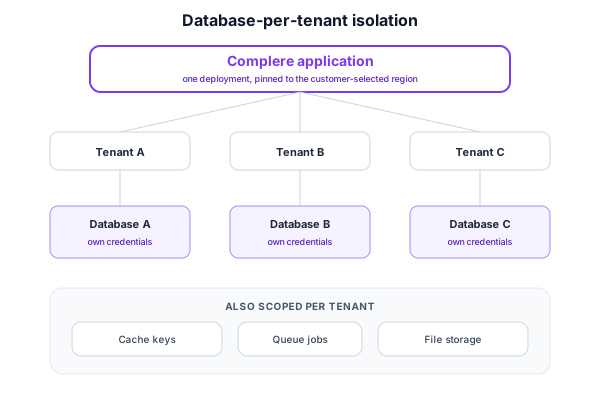
Multi-tenant architecture with per-tenant database scoping. Cross-tenant queries, cache keys, and queue payloads are blocked at the application layer and re-tested with every regulated release as part of the validation programme.

Audit trail & logging

ALCOA+ records, per-table history

Every create / update / delete on regulated records is captured in a per-record history table with actor, timestamp, and old / new values. Audit records are immutable from the application layer and align with ALCOA+ data integrity principles.

Network controls

IP allowlist / blocklist per tenant

Tenant administrators can restrict platform access to defined IPv4 ranges (allowlist) or block specific ranges (blocklist). Enforced at the application gateway before authentication; supports VPN-only or office-only access models.

E-signatures

Re-authentication on signed actions

Status transitions and approval actions that require an electronic signature force the user to re-authenticate (SSO ID-token validation or password re-entry) at the moment of signing — Part 11 / Annex 11 aligned.

Authentication

SAML 2.0 SSO + RBAC

Customer-side: SAML 2.0 SSO with major identity providers, role-based access control with granular permissions, password and session policies, optional API tokens for service integrations.

Abuse protection

Per-user & per-IP rate limiting

API requests are rate-limited per authenticated user, with stricter per-IP limits on authentication and SSO endpoints to throttle credential-stuffing and bot traffic. Failures are logged for monitoring.

Backups

Automated backups

Tenant data is backed up on a regular schedule with point-in-time recovery available within the retention window defined per environment. Restore procedures are exercised on a defined cadence and recorded as part of operational evidence.

Software lifecycle

Change discipline

Code changes follow peer review, automated testing, and controlled deployment. Production change records are retained. GxP-impacting changes are managed through formal change control.

Data protection

Where customer data lives, who can reach it, and how it stays portable.

Residency

Region pinned at provisioning

Tenant data resides in the cloud region selected at the time of provisioning. Cross-region replication, where used, is documented per environment.

Retention

Configurable per record class

Retention windows for documents, training records, audit history, and CAPA evidence are configurable to match your quality manual. Soft-delete plus audit history preserves chain of custody.

Portability

Customer-initiated export

Customers can request structured export of their tenant data (records, attachments, audit history) in machine-readable form for migration, regulatory submission, or archival purposes.

Termination

Defined deletion procedure

On contract termination, customer data is deleted per the procedure in the Data Processing Addendum, with written confirmation provided on request. Backup retention follows the schedule referenced in the DPA.

Maintenance

Controlled outage windows

Scheduled maintenance is announced in advance through the customer admin contact. Production deploys are gated through change control with a maintenance-mode middleware that returns informative 503 responses, not silent failures.

Validation evidence

CSV pack on request

Validation Master Plan, URS, IQ / OQ / PQ test scripts, and traceability matrix are available to support your computer system validation and inspection readiness.

Sub-processors

Third parties that may process customer personal data on Complere's behalf.

Sub-processor Purpose Region
Cloud infrastructure provider Compute, managed database, object storage, network for hosted tenants Customer-selected region
Email delivery provider Transactional email (notifications, password resets, system alerts) Provider-managed
Error monitoring service Application error and performance monitoring; access restricted to engineering on-call Provider-managed
Customer support tooling Ticket management for customer-initiated support contact Provider-managed
Current vendor names available on request via DPA. Material changes to sub-processors are notified to customers through the contact channel on file.

Incident response & breach disclosure

What to expect if a security event affects customer data.

Notification SLA

Within 72 hours

In the event of a confirmed personal data breach affecting a customer, Complere notifies the impacted customer without undue delay and, in any case, within 72 hours of becoming aware — aligned with GDPR Article 33.

Channel

Designated contact

Notification is sent to the security or admin contact listed on the customer account. Customers should keep this contact current and inform Complere of changes.

Information provided

Nature, scope, mitigation

Notifications describe the nature of the incident, categories of data affected, likely consequences, mitigation steps taken, and recommended actions for the customer's own assessment.

Documents available on request

For procurement, legal, and IT security review.

Trust summary

Trust Summary (1-page PDF)

Single-page summary of security, validation, and compliance posture for fast procurement / IT-security review.

Request Trust Summary
Validation

Traceability matrix sample

Per-module sample showing the URS → FRS → RA → CS → TEST → CI artifact chain, with a worked example QA teams can drop into their own validation pack.

Request matrix sample
Privacy

Data Processing Addendum (DPA)

GDPR-aligned DPA including SCCs for international transfers and the current sub-processor list.

Request DPA
Security

Security overview

Summary of technical and organisational controls, suitable for inclusion in supplier risk assessments.

Request overview
Procurement

Security questionnaire response

Pre-filled responses to common questionnaires (CAIQ-style) on request; bespoke questionnaires accepted.

Request response
Commercial

Service Level Agreement

Uptime commitments, support response targets, and incident communication standards.

Request SLA

Have a security or privacy question?

Reach out to our team for documents, questionnaire responses, or specific clauses your procurement process requires. We respond within one business day.