
Efficiency
Reduce validation cycle time
Complere provides pre-built Validation Master Plan templates, User Requirements Specifications, and test script frameworks so teams do not start from scratch.
eQMS validation buyers need more than generic compliance claims. Complere supports a risk-based Computer System Validation lifecycle with CSV and CSA-aligned evidence, from Validation Master Plan and URS through IQ/OQ/PQ and ongoing change control, aligned to GAMP 5, EU GMP Annex 11, and FDA 21 CFR Part 11.

How this module improves quality operations, reduces compliance risk, and supports inspection readiness for regulated teams.
Complere provides pre-built Validation Master Plan templates, User Requirements Specifications, and test script frameworks so teams do not start from scratch.
Apply GAMP 5 risk classification to determine the right depth of testing — focusing effort on business-critical workflows without over-validating low-risk features.
Post-go-live changes, patches, and configuration updates flow through controlled change requests that preserve qualification evidence and periodic review records.
Regulated buyers need more than a slide on “GAMP” — they need clarity on deliverables, testing approach, and what happens when the system changes after go-live.
A structured package aligned to your VMP: risk assessment, URS traceability, configuration specification where applicable, IQ/OQ/PQ or equivalent test evidence, deviation handling, and release records — organized for internal QA sign-off and auditor review.
Risk-based testing emphasis on intended use and patient/product impact — consistent with modern FDA thinking on CSV/CSA so effort focuses on critical workflows, not low-risk UI noise.
Executed test scripts with pass/fail results, evidence attachments, and approvals; release documentation that shows what was qualified and what is in production use.
Controlled assessment of platform updates and configuration changes: impact analysis, re-testing or regression scope, and updated qualification evidence so the validated state is maintained after patches and releases.
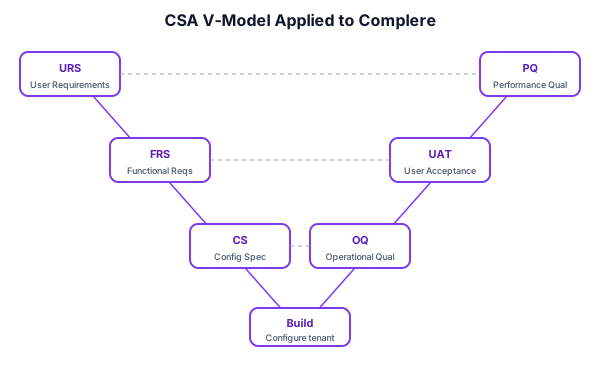
Each step in this workflow is supported by governed records, electronic signatures, and a full audit trail — so quality operations stay traceable and inspection-ready.
Agree scope, risk classification, team responsibilities, and validation milestones before configuration begins.
Document what the system must do, linked to the business process and compliance obligations it supports.
Configure the system and execute IQ test scripts that confirm the platform is correctly installed in the production environment.
Run OQ scripts to verify each function performs as specified, then PQ tests to confirm operational performance under real-world conditions.
The specific controls, features, and workflow functions built into this module to support your quality and compliance objectives.
Define the overall strategy, scope, responsibilities, and acceptance criteria for the validation programme before configuration begins.
Structured templates capture business requirements, linking each to the test evidence that confirms the system meets the intended purpose.
Executed test scripts with pass/fail evidence, deviation notes, and approval signatures at each qualification phase.
Configuration changes, upgrades, and new module deployments follow a governed change process that preserves and updates qualification evidence.
What ships in the validation pack? See the Validation Pack TOC — 9 artefacts per module on day one (VMP, URS, RA, TM, IQP, OQP, PQT, Part 11 checklist, ATS).
Our team works with validation leads, quality directors, and IT partners to scope the qualification package and plan a realistic implementation timeline.